Spells
Characters discover spells through research in their spell fields. Each spell belongs to one or more fields and has a tier. Greater proficiency gives a character access to higher-tier spells in that field. Characters can also gain spells from rewards or as innate grants.
Spell fields
Spell fields group spells by what they do. Class research support opens up fields for discovery.
Spend  Lore to buy proficiency in a field. The three ranks are Adept, Expert, and Master.
Proficiency helps you discover stronger spells and can unlock class promotions and skills.
 Augmentation,
 Divination,
 Evocation,
 Illusion,
 Nature,
 Necromancy,
 Self-Imbuing,
 Shapeshifting,
 Spiritual.
Casting spells
A spell’s target and timing determine how it fits into an activity or battle.  Magic Power can
affect the strength of the spell. Casting can also expose the caster to
 corruption.
| Context | How spells work |
|---|---|
 Outside battle |
Maintained spells can keep an effect active on a character or party, with corruption costs that depend on the spell. |
| In battle |  Instant spells resolve when cast.  Enchantments can remain active across combat rounds. |
Some spells can be used in both contexts, with different effects or costs.
Memory
Learned spells each use one  memory slot. Innate spells use none.
| Memory slots |  Learning required |
|---|---|
| 1 | 0 |
| 2 | 2 |
| 3 | 5 |
| 4 | 9 |
| 5 | 14 |
| 6 | 20 |
Capacity uses uninjured Learning. Some advancements grant extra slots independently of Learning.
Replacing or upgrading a spell
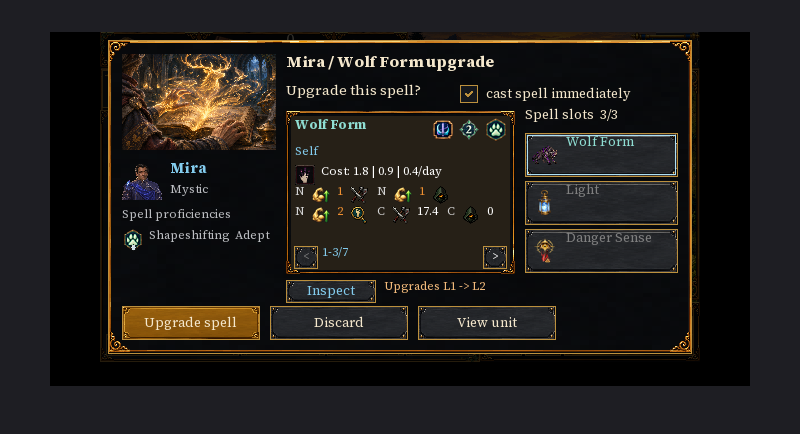
Learning a spell in an occupied slot replaces the spell held there and ends its maintained
effects. A stronger spell from the same family upgrades the existing slot, as shown here for  Wolf Form.